How credits are charged
What each operation costs in credits, how holds are settled and refunded, and which work is free.
Last updated 2026-10-23
RenewSell charges credits for the work it does. Before a billable operation starts, RenewSell holds an estimate; when it finishes, the hold is settled against the actual amount, and a failure or cancellation returns the whole hold. Every plan uses the same unit prices. A plan only changes the monthly allowance, how many accounts you can connect, the result ceiling per list, and which channels are available.
Unit prices
| Operation | Billed per | Credits per unit |
|---|---|---|
| Contact discovery | Unique company domain | 1 |
| Email verification | Address (1 credit / 5 verifications) | 0.2 |
| Enrichment field | Item and field | 1 |
| Qualified lead | Qualified lead | 5 |
| Company research | Report | Actual model compute: $0.005 per credit; up to 25 per report |
| Customer interaction | Sent message (1 credit / 10 messages) | 0.1 |
| Monitor run | Monitor run | 0 |
| Channel maintenance | Connected channel / month | 500 |
| Inbound reception and qualification | Reception and qualification conversation | 10 |
| Customs trade data | Returned customs row | 3 |
Credits are recorded to 0.1. Balances, holds and the ledger all use that precision, so 15 email verifications cost 3 credits.
Holds, settlement and refunds
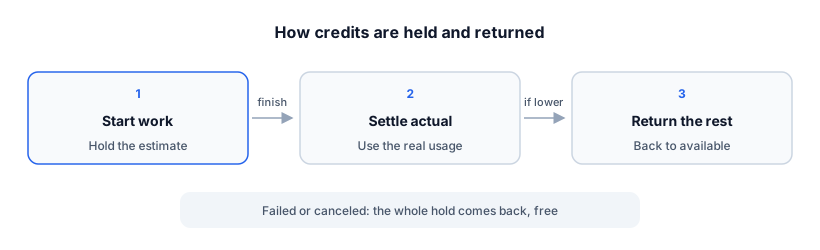
- Before work starts, RenewSell holds the estimated credits. The hold appears under Reserved and still counts toward Total, but no other work can use it.
- When the work finishes, the hold is settled at the actual amount and the difference is returned.
- If the work fails or is canceled, the whole hold is returned and the work costs nothing.
How that plays out per operation:
- Enrichment field: only a finished cell with evidence is charged. No evidence, a failed run or a cancellation is returned. Research depth does not change the price.
- Qualified lead: searching and evaluating criteria are free. Only a result that meets every criterion and cites evidence costs 5. The same company in the same Target is charged once across search rounds; a different Target is charged separately.
- Contact discovery: billed per company, not per contact found. A search that finds no contacts still costs 1 credit; a failed or canceled search is returned.
- Email verification: 0.2 per address. Whether the address turns out valid does not change the charge; a failed or canceled verification is returned.
- Customer interaction: only a message that is actually sent is charged. Messages skipped for suppression, a paused plan, the send window or low credits are free, and a failed send is returned. A LinkedIn like is an outward action as well and costs the same as one message.
- Company research: RenewSell holds 25, then settles at the actual model compute converted to credits, capped at 25; the difference is returned. If the actual compute cost is unavailable, the report is not charged.
- Inbound reception and qualification: the first reception in a conversation that ends in a reply, a handoff or a stop costs 10. Later messages in that conversation are charged as Customer interaction. Conversations that are not received, are skipped, fail at the model or happen in a debug preview are free.
- Customs trade data: billed per returned row, and a query that returns no rows costs nothing. Resolving a company name before a query is free.
- Channel maintenance: 500 when the channel connects, then once per UTC calendar month. Disconnecting stops the charge, and missed months are not back-charged. If credits run low the channel stops sending; after a top-up, reconnecting costs the current period again.
A search's credit ceiling
When a search starts, RenewSell holds credits for the requested number of results (5 per result) and returns the part it did not fill when the search ends. A search plan can set a Credit budget: once the search reaches it, planning stops and the work already dispatched finishes normally.
Work that is free
- Searching and evaluating criteria
- Monitor run runs (qualified leads and enrichment found by a monitor are charged as usual)
- Knowledge base generation
- The Agent setup wizard
- Previews and test conversations
- Marking or unmarking the outreach hook
- Enrichment cells with no evidence
- Messages that are skipped or fail to send
- Customs queries that return no rows, and the company name lookup before a query
Where to check
The Credits page shows Available, Reserved and Total, with the Ledger underneath. The ledger records seven kinds: Grant, Purchase, Reserve, Settle, Refund, Expiry and Adjustment. Settle is the actual charge and Refund is money returned. The What work costs table on the same page lists the same unit prices for the operations you use in the app; the customs price is in the table above.
Subscription and purchased credits are shown separately: Subscription available is the part funded by the current subscription allowance, which expires at the next reset; Purchased / permanent is the add-on part that never expires. See Plans, seats and credit packs.
When credits run out
New billable work cannot start. A Target shows Paused: not enough credits, or stops with Stopped: not enough credits to pay for another result. Top up or wait for the next monthly allowance to continue.
Where the customs price lives
Customs trade data is used through the API and MCP, and the number of returned rows sets the cost. The price is in the table above; how to run a customs query is in Customs data.